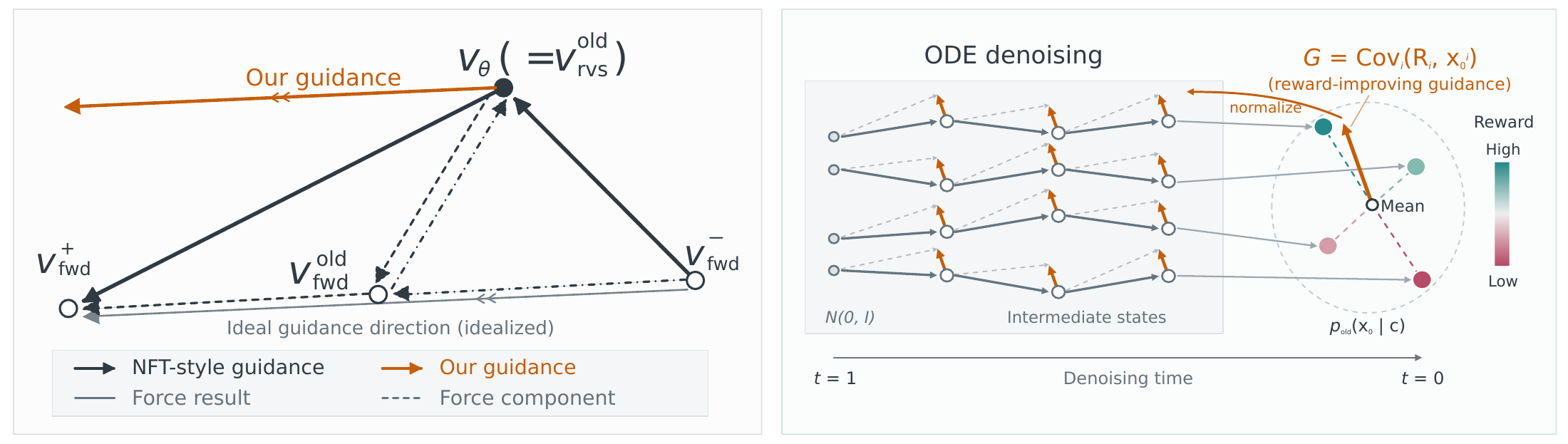
We study its hidden forces through DiffusionNFT, then rethink guidance and restoration.
Why do two promising branches collapse?
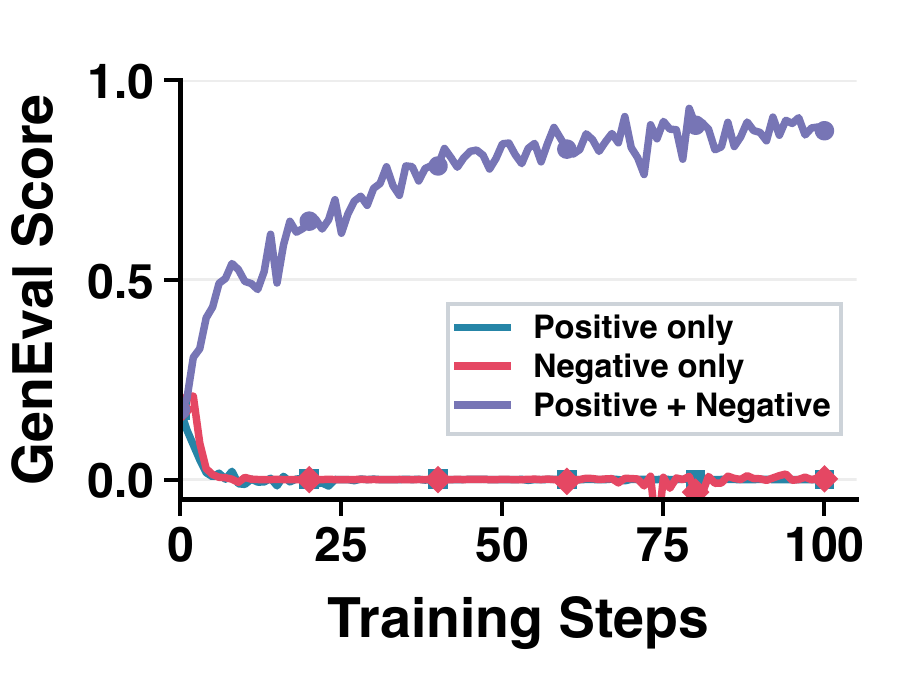
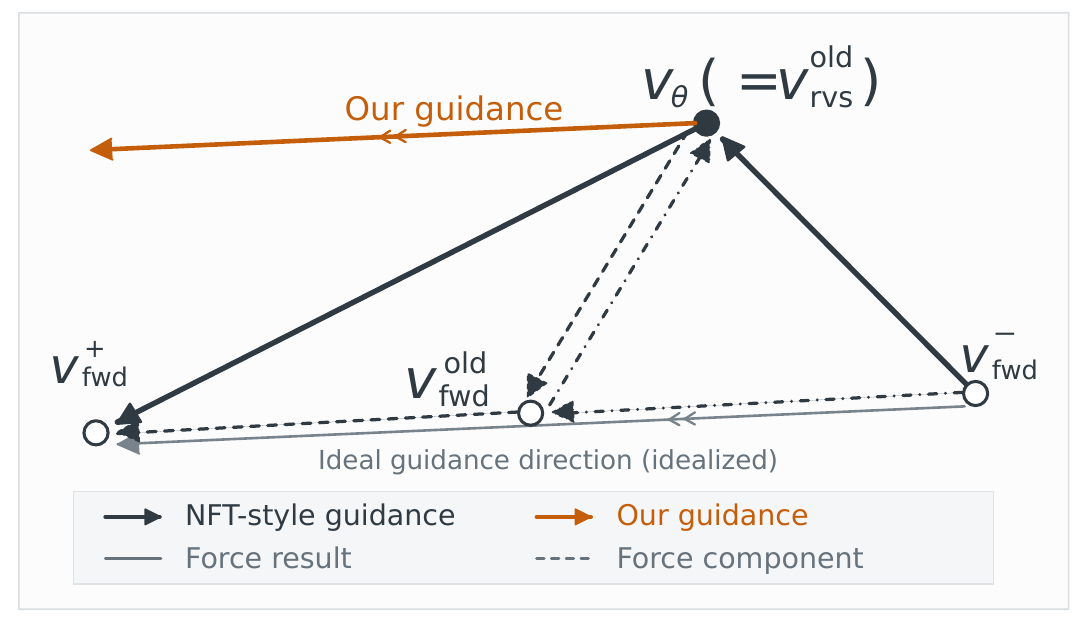
Ideally, the positive and negative branches follow the same reward-improving direction. Yet either branch alone collapses in our on-policy ablation, while joint training learns.
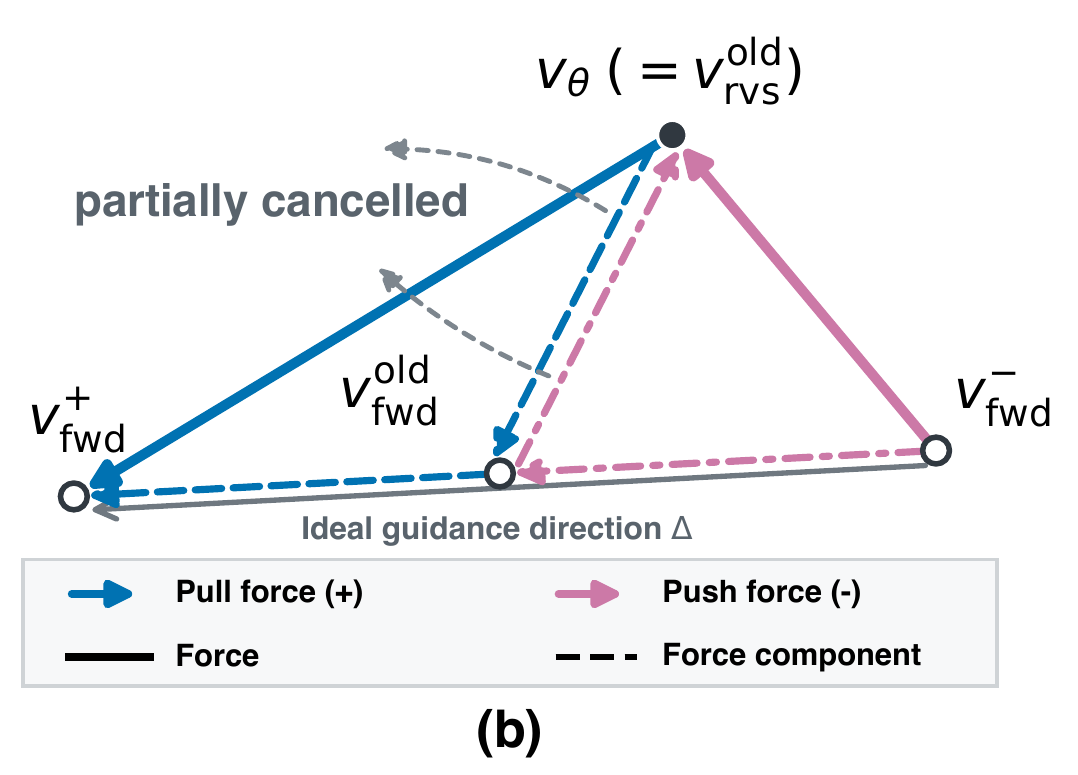
DiffusionNFT's objective contains an implicit forward–reverse consistency term. Its uncancelled force can destabilize training and slow reward improvement.
Reward guidanceHidden consistency force
The branches reinforce guidance but oppose the consistency force. Centering rewards across samples does not balance the forces at every state, so joint training cancels them only partially.
Remove the consistency force state by state, rather than rely on cancellation across samples.
The forward–reverse gap and symbols
Generated endpoints induce an ideal forward velocity that can differ from the reverse sampler's velocity. Their difference is the consistency gap e. The formula is the normalized output-space force at on-policy initialization for the NFT objective. With goodness weight r in [0,1], q = E[r | sₜ] and g = Cov(r, uₜ | sₜ), where uₜ = x₀ − ε is the rectified-flow target. See Section 3.1 of the paper.
Each branch alone collapses, despite the same ideal guidance direction.The forward–reverse gap introduces opposing forces that only partially cancel.
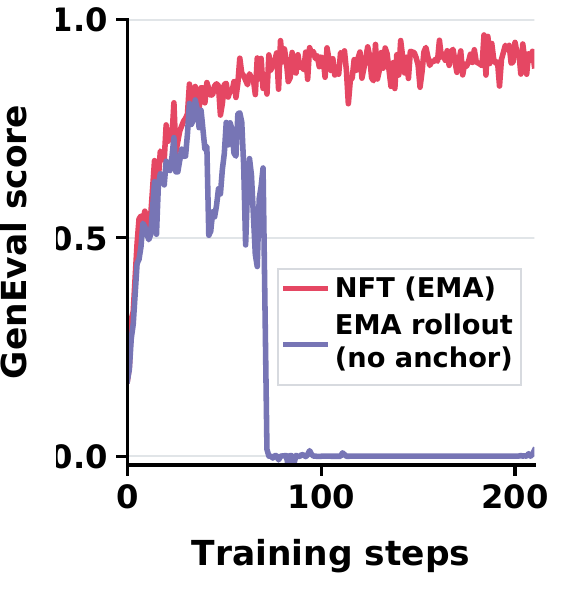
EMA rollouts alone do not prevent collapse when the restoring anchor is removed.
Restoration is crucial, not just EMA data.
What does EMA actually stabilize? Keeping EMA-policy rollouts but removing the restoring reference still causes collapse in our ablation. Off-policy data alone is insufficient.
The NFT objective already contains a restoring anchor: rewriting its loss reveals a quadratic penalty on drift from the frozen rollout policy. EMA keeps this reference lagged, making restoration active as the policy moves.
Our NFT ablations identify restoration as the crucial stabilizer for this form of diffusion RL.
Reward & consistency forcesRestoration to the reference
d = vθ − voldh = ut − vold
Loss decomposition and definitions
The expectation is over old-policy training data. vold is the frozen rollout-policy prediction, ut = x₀ − ε the forward velocity target, r ∈ [0,1] the reward-derived goodness weight, and β the NFT tilt coefficient. The constant does not depend on trainable parameters. The linear term carries both reward guidance and consistency force; the quadratic term restores the prediction to the reference. Its gradient vanishes at d = 0. This term is part of NFT's objective, not an extra regularizer added by EMA. See Section 3.2.
Stable does not always mean fast.
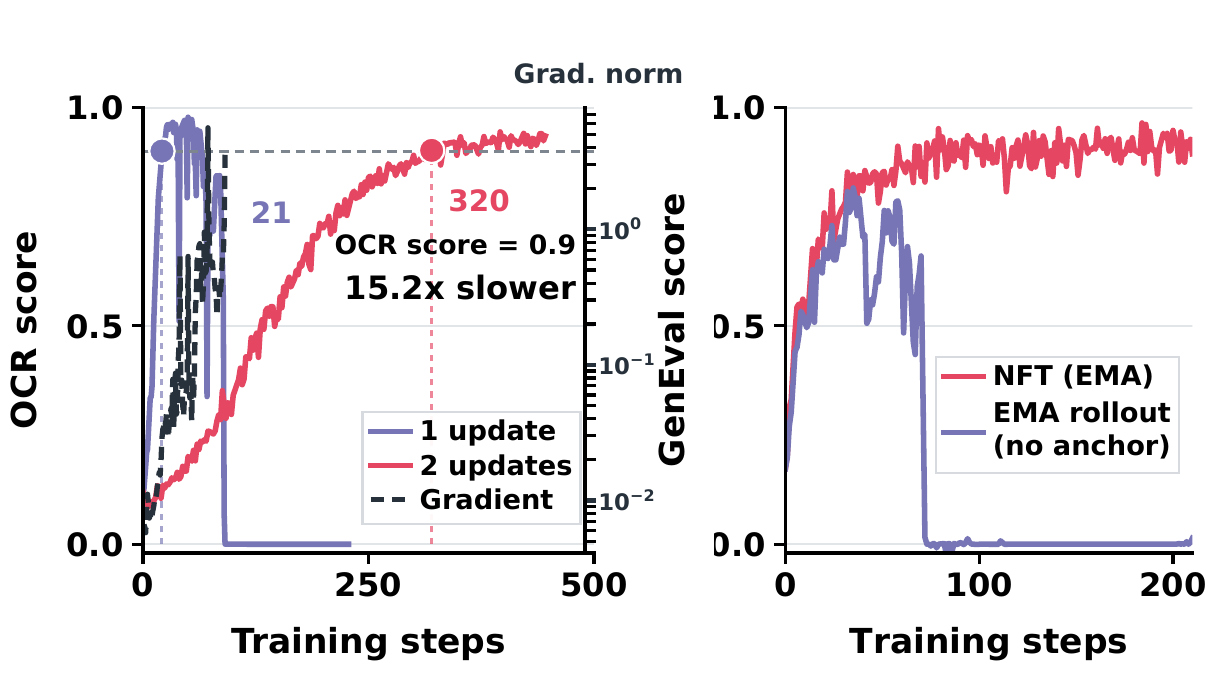
Without EMA, two updates on disjoint minibatches retain one frozen reference. The first creates drift; the second adds restoration. Collapse disappears over the observed window, but reaching OCR 0.9 takes 15.2× more steps.
Left: no EMA, β = 1; 21 versus 320 updates to OCR 0.9. Right: removing the anchor despite EMA-generated data.
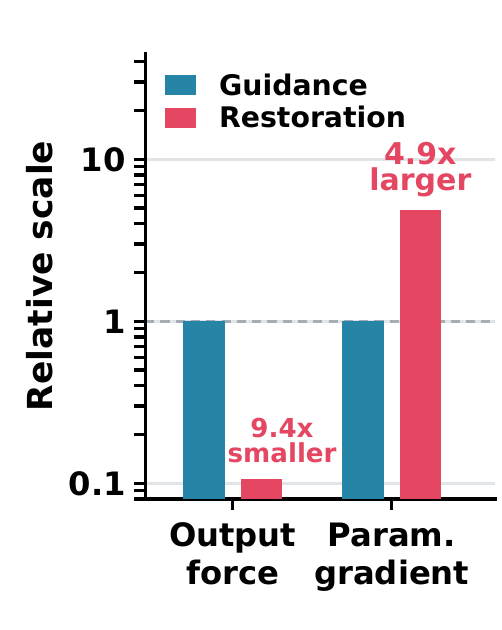
A small force can dominate the gradient.
Restoration has 9.4× smaller output-force RMS than guidance, yet a 4.9× larger aggregated parameter-gradient norm. This suggests heterogeneous guidance cancels across states while restoration survives aggregation.
Second-update gradients, averaged over rollouts 0–17. These are observed ratios, not a universal scaling law.
Preserve restoration without letting it overwhelm reward guidance. This is the balance DiffusionART is designed to achieve.
Change the order. Remove the force.
Aggregate endpoints and rewards before regression, then reuse a frozen target.
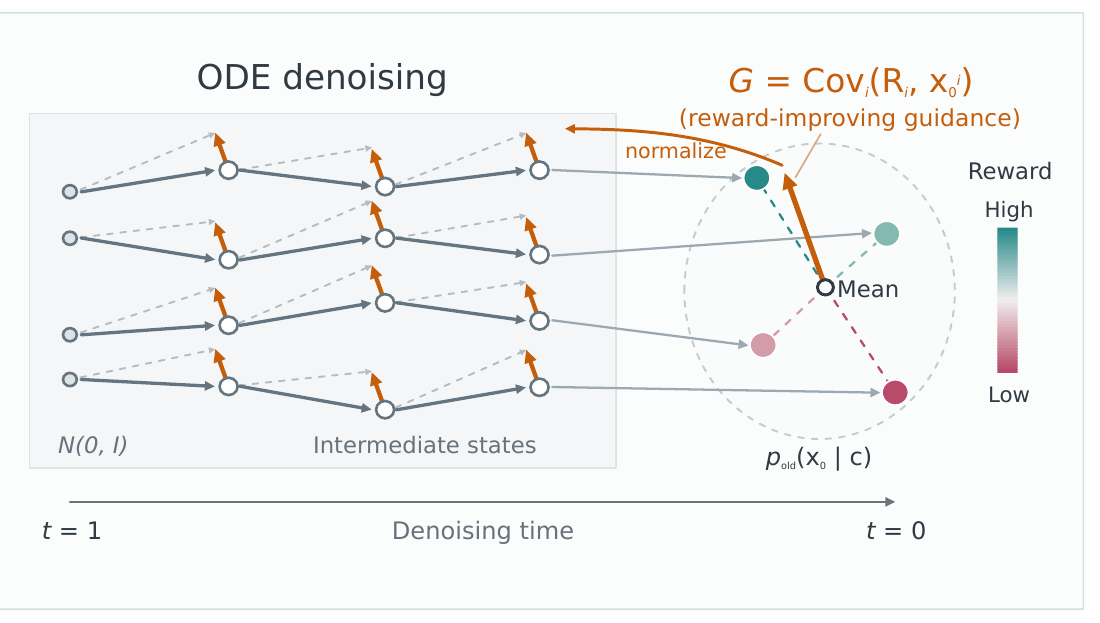
One direction for each prompt
Reward–endpoint covariance supplies shared guidance on the states actually visited by the reverse sampler. Normalize after aggregation, rather than relying on samplewise forces to cancel.
For nonzero covariance; otherwise G(c) = 0.
R is reward, x₀ a clean latent endpoint, and c the prompt. The covariance is estimated over its K samples.
Two updates. One frozen target.
Fit vold + G on two disjoint minibatches. The first update follows guidance; the second also restores the model in proportion to its output drift.
First update
Second update
Directions in output space, up to the MSE scale and state weight; d = vθ − vold. A trust-region mask suppresses excessive outward updates.
No differentiable reward model. No EMA schedule to tune.
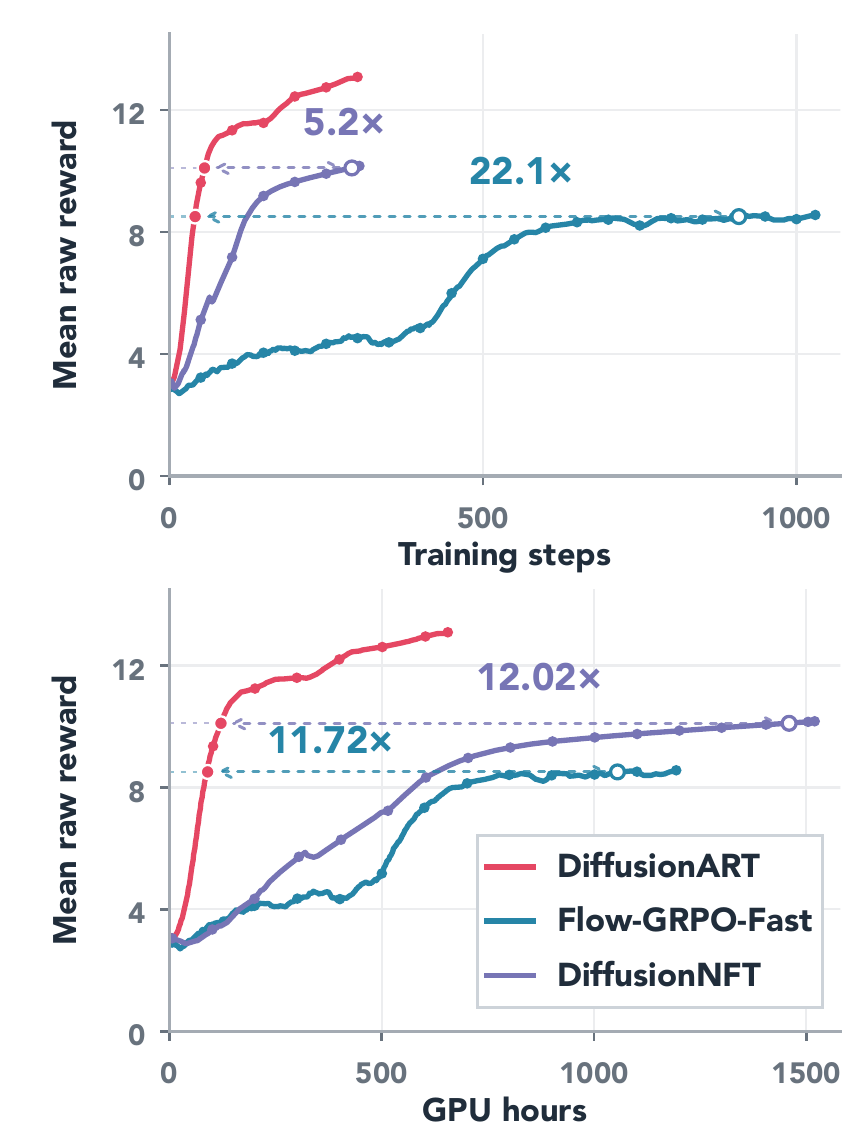
Less compute. Higher rewards.
Matched HunyuanVideo-13B experiments with VQ:MQ = 1:1.
The same reward, reached earlier. Then a higher reward.
DiffusionART versus each baseline
Baseline
Fewer GPU hours
Higher reward
DiffusionNFT (EMA)
12.02×
+28.8%
Flow-GRPO-Fast
11.72×
+53.0%
Mean raw reward is (VQ + MQ) / 2. Speedups compare the first crossings of each baseline's final-50-update mean reward. Reward gains compare the final 50 logged updates of each method.
Measurement protocol and data
All methods use an eight-update causal EMA for crossing measurement. Targets are unsmoothed baseline means; crossings use observed points, without interpolation. Elapsed GPU hours include evaluation and waits. The baseline levels are empirical late-stage rewards, not a guarantee of asymptotic convergence.
@misc{wan2026diffusionartefficientstablescalable,
  title={DiffusionART: Efficient, Stable and Scalable Reinforcement of Diffusion Models},
  author={Zhenglin Wan and Jiayu Chen and Zhengfeiyang Zhang and Pengfei Zhou and Wangbo Zhao and Fangyuan Kong and Pengfei Wan and Kun Gai and Yang You},
  year={2026},
  eprint={2610.12572},
  archivePrefix={arXiv},
  primaryClass={cs.LG},
  url={https://arxiv.org/abs/2610.12572},
}

 Code
Code Demo
Demo